Lionel Messi's father, Jorge Messi, passed away on August 8 at the age of 68. TA wrote an article expressing condolences for Jorge Messi , stating that he was not only Messi's father but also his agent and one of his most trusted people.
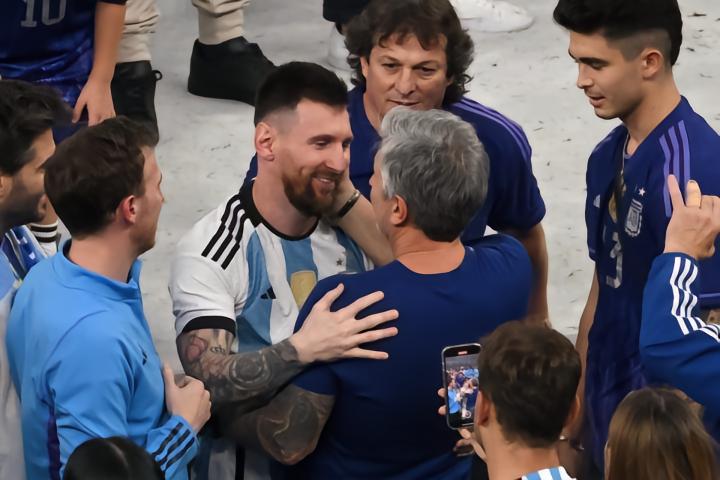
We've seen Messi standing alone on the pitch, heartbroken. His biggest defeats always seem to leave him feeling isolated. What more can be said about someone who has achieved such ultimate success on the field? For Messi, that rational voice, that shoulder to lean on, is his father, Jorge. Whether his son is at the peak or in the trough of his career, Jorge is always there, quietly managing the hundreds of millions of dollars worth of Messi's brand. He is both his son's agent and a steadfast negotiator in front of one of the greatest athletes of all time. But beyond the headlines and business deals, he is, above all, a supportive father.
Jorge recognized Leo's talent earlier than anyone else on Earth. When many around him saw only a thin child with growth problems, he saw greatness. In 2000, Jorge packed his bags and took his 13-year-old son across the Atlantic to Barcelona, a move that changed football history. It sounds like a Hollywood script, but few boys that age—let alone one only familiar with the Rosario environment—are ready to leave home thousands of miles away, leaving behind their mother and siblings.
“My father has always been by my side. We’ve been through a lot of bad things together,” Messi said in a 2007 interview with Radio Del Plata. “Sometimes I would lock myself in my room and cry alone, or he would do the same, without me seeing. We pretended everything was okay, but it wasn’t. My father would ask me, ‘What do you want to do? Continue or go home?’ I wanted to continue, so he stayed with me.”
The life of a footballer was initially foreign to Messi. His father was a fervent fan of Newell's Old Boys and worked as a manager at a local metalworks. Players like Newell's, Boca Juniors, River Plate, and the Argentine national team were considered god-like heroes. Jorge introduced young Messi to the traditional culture of Argentine football and encouraged him to play—after all, this was something parents often did.
“My father gets up at four in the morning almost every day and comes home for dinner at nine in the evening,” Messi told TyC Sports in 2019. “We rarely see each other, but when we do, he enjoys my company. He never scolds me. I love him very much and I wait for him to come home just to hug him and be with him. He spends all his time on his work, really.”
In Ariel Senosiain's 2023 book, *Messi: The Complete Genius*, Jorge gave a rare public interview, discussing his star son and the bond that initially defined their relationship. He denied any claims that Messi disliked football as a child—a rumor that once circulated in Argentina. "It's not true," Jorge said. "He has always loved the sport."
In that interview, Jorge readily accepted the long-standing comparisons surrounding his son to Argentine football icon Diego Maradona. Such discussions typically focus on Maradona's shadow and the late Argentine captain's global influence. But Jorge chose to remember it differently, like a proud father. "We went to Newell's games together," he told Senosiain. "It became a daily routine after he started playing for that club at age seven. When he was ten, he watched a Newell's game against United Santa Fe from the sidelines. During halftime, he started juggling the ball, and the fans started chanting 'Maradona, Maradona' (a term used to pay tribute to Maradona years ago)."
“I always watch his games alone, and I still do,” Jorge continued. “I try to sit as far away from everyone as possible. When he was in the Barcelona youth team, he would sometimes drift off during the game. I would try to get him to look at me, give him a signal, encourage him, and get him moving. He would wave at me and tell me to leave him alone. But then he would refocus and do some beautiful things with the ball.”
Jorge gave a public and generous interview after Messi led Argentina to victory in the 2021 Copa America, ending Argentina's 28-year trophy drought. Messi had already won the Ballon d'Or, La Liga, and two Champions League titles. This was a rare interview, coming after years of relentless scrutiny within Argentina for his national team's failure to win a title.
When Argentina lost 0-1 to Germany in extra time in the 2014 World Cup final, Messi's lonely gaze at the Maracanã Stadium in Rio de Janeiro became an eternal image of that epic clash. The following year, after a penalty shootout loss to Chile in the Copa America final, his despair was equally palpable. His empty expression captured a moment he couldn't comprehend: Why him? Why now? Another year passed, and in the Copa America Centenario final, Argentina was again defeated by Chile in a penalty shootout. Messi's penalty kick flew over the crossbar. He wept on the pitch, then abruptly announced his retirement from the national team, succumbing to the despair of that moment. As the world questioned his reasons, he retreated to the intimate circle of trust that only his family could provide. One can imagine that he had to rely on his father, perhaps through conversations over mate tea, to ultimately convince himself to change his mind. Because in the moments when Messi seemed trapped in his own world, his father was always there, just a phone call away.
If the 2016 Copa America final was the most painful moment of Messi's career, then he is enduring even greater pain today. Perhaps the only solace after losing a loved one is that Jorge witnessed his son's recent journey toward eternal greatness: a tumultuous World Cup campaign in 2022 culminating in a victory over France in the final; his eighth Ballon d'Or in 2023; and the Copa America final victory over Colombia in 2024. And of course, there's Argentina's hard-fought run to the 2026 World Cup final last month—with Messi at the forefront—making this journey all the more poignant given what we now know about his struggles off the field.
Previously accused of being overwhelmed by the pressure of representing Argentina, Lionel and Jorge celebrated all the symbolic victories together. Messi continued to play for his country, even as Jorge faced health issues during the World Cup. After scoring the first of his three goals in the opening group stage match against Algeria on June 16, Messi was visibly emotional. "It has absolutely nothing to do with football," he told reporters after the game. "I've been going through some tough days."
Words cannot ease the pain Messi and his family are experiencing right now. Losing a loved one changes a person. But this is unlikely to be what Jorge would have wanted his son to see—Messi is now a father of three. In a video he recorded for him in 2007, Jorge encouraged Messi to remember the lessons life teaches us from adversity. “We always become stronger,” he said. “It helps you become yourself, because I believe that beyond being a great footballer, you are a great person. I say this not because you are my son, but because most people who know you know this. So I hope this stays with you throughout your life. I hope you stay true to yourself, and people will love you for that.”