
On August 10, Beijing time, the European, Asian, and North, Central American and Caribbean Football Confederations issued a joint statement, reiterating their dissatisfaction with FIFA's plan to form an FFE and sell the World Cup, while also questioning FIFA's handling of the matter.
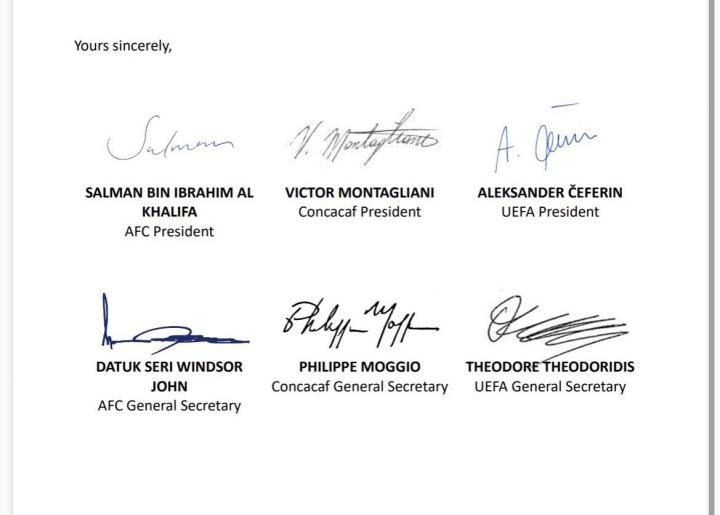
Signatures of the presidents and secretaries-general of the three continental football federations
Joint Statement Content
To the football family:
Football is the world's greatest shared passion. It belongs to no one individual or organization.
It belongs to the players, fans, clubs, member associations, and all institutions that bear the mission of safeguarding its future.
That is why, as a federation representing our respective members, we are speaking out today in a collective capacity.
The progress of the past decade is real. But this progress has never been the achievement of any one person; it is the result of the collective efforts of FIFA, the continental football federations, member associations, and the tens of thousands of people who have dedicated their lives to the sport.
The expansion of the tournament, the awarding of the 2030 and 2034 FIFA World Cups, and the allocation of resources to various associations are all achievements made together, agreed upon and implemented by all parties.
This is not a matter of money. The continental football federations have called for the responsible allocation of FIFA's existing huge reserves to further increase investment in the development of member associations.
This is not intended to deprive any member association of the support it deserves, despite attempts to sow panic among our members and create the opposite impression. Nor is it to re-examine decisions made collectively, such as tournament expansion, World Cup qualification allocation, or any other decisions already made collectively. These decisions were made collectively and must remain in effect.
This concerns a more fundamental issue: the integrity of the movement, and the integrity that should be possessed by those elected to lead it.
Leadership in football is not private property. It is not about holding—or demanding to be held—power, but about assuming a responsibility to serve the football family that has entrusted it with this responsibility.
Trust is broken by deception, and responsibility is abandoned when someone places themselves above the collective that empowers them.
A recent letter from FIFA to its vice presidents and 211 member associations acknowledged errors in the process. The letter described this as a communication breakdown, while the football community perceived it as a misjudgment. Pushing forward a proposal under pressure, lacking meaningful consultation, and pushing it to a deadline before member associations had adequately reviewed its terms was not a product of negligence, but rather a result of a deliberate design that limited the review process.
The letter also failed to acknowledge that the proposal itself was a fundamental error. It has yet to admit that attempting to sell FIFA's World Cup rights was a serious misjudgment, not only a procedural impropriety but also a fundamental betrayal of trust in the very institutions FIFA serves.
FIFA also pledged to submit a full report on these incidents to the FIFA Council, but again failed to recognize that, given such serious misjudgments, proper governance requires a review by a completely independent third party, not by FIFA itself, its staff, or any other stakeholder in football. FIFA's management should not be involved in this review.
As required by the previous letter, all relevant documents and records must be retained in accordance with UEFA's notice on document retention.
A letter from FIFA itself also confirmed that only one elected official attended the leadership meeting held in Morocco. No FIFA Council members or member associations were invited. Only the management committee, composed of senior staff hired by FIFA, was present.
This latest meeting only further confirms these concerns: instead of the entire management committee, a select few were summoned overseas to face FIFA's core members—its staff—in Zurich. This indicates that the pattern of behavior that led us to where we are today continues. This is not the behavior of a guardian of football, but the behavior of someone who believes football must be accountable to him.
Where accountability should be sought, there is only silence; where openness should be maintained, distance is kept.
These are not qualities that football should have in its leadership. That is why we have taken this position: not rashly, nor acting alone, but collectively, out of a sense of responsibility to the sport we serve.
The power of football has always lay in unity. We call for respect for this unity today, and for leadership that serves football, not attempts to dominate it.