FIFA President Gianni Infantino faced pressure from multiple sides this Monday, with UEFA and two other continental football federations jointly sending a letter opposing his plans, and the Spanish Association for Sports Transparency and Democracy also filing a complaint with FIFA's Ethics Committee.
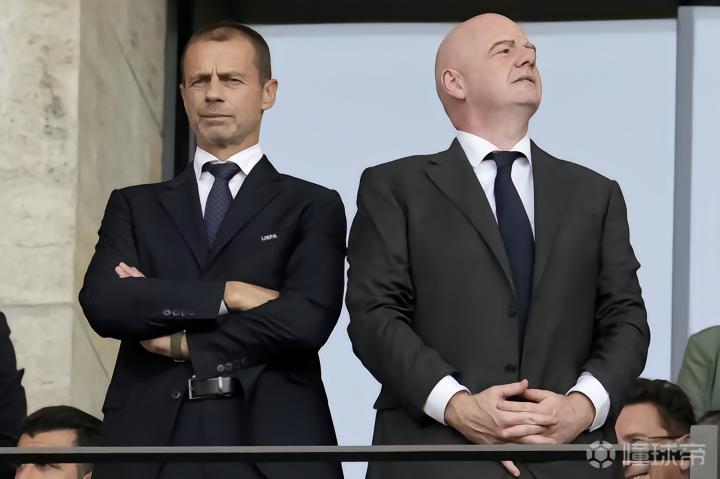
UEFA, the AFC, and CONCACAF issued a joint open letter this Monday opposing Gianni Infantino. The letter accuses the Italian-Swiss president of undermining FIFA's leadership through deception, stemming from his attempt to establish a subsidiary called "FIFA Future Enterprise" (FFE) to commercially operate the men's and women's World Cups with 20% private capital, a plan that ultimately failed.
Subsequently, the Sports Transparency and Democracy Association, led by Miguel Galin, filed a complaint with FIFA's Ethics Committee, requesting an investigation into Gianni Infantino. Galin had previously successfully brought down two former presidents of the Spanish Football Federation, Ángel María Villar and Pedro Rocha, through criminal charges. According to El País, the complaint calls for an investigation into whether Infantino violated regulations in three areas: his rejected plan to commercialize World Cup broadcasting rights, the establishment and awarding of the FIFA Peace Prize to Trump, and the Balogun incident—American striker Balogun was shown a red card during the World Cup, but the card was unprecedentedly revoked after the US president called the FIFA president, allowing him to play in the Round of 16 match against Belgium.
Gianni Infantino's plan to bring in private capital to develop the World Cup broadcasting rights has met with strong opposition from governments, institutions, leagues, and players. The agreement had listed Thrive Capital, founded by Jared Kushner's brother Josh Kushner (who is Trump's son-in-law), as a potential investor. The letter stated, "The power of football has always been unity. We demand respect for that unity now, and leadership that serves football, not attempts to control it." The three continental football federations urged FIFA to submit a report on the matter, written by "an independent third party, not FIFA itself, its staff, or any other player in football."
In his 23-page complaint, Galin requested FIFA's Ethics Committee to investigate three instances of Infantino's misconduct (without yet seeking punishment). He argued that these actions could damage "the integrity and reputation of football." The first involved the FFE program, a subsidiary valued at approximately €20 million. This controversial program, revealed by The Times on July 28, sparked widespread opposition and was ultimately withdrawn. The program was originally intended to provide €40 million annually to 211 member associations between 2027 and 2031. Infantino himself met with FIFA officials in Rabat on August 5, after which FIFA issued a statement acknowledging "mistakes" and stating that it "never intended for the FIFA Council and member associations to feel excluded from the process" and that "it should have been handled differently."
In her complaint, Garland requested that the investigation determine "who conceived, promoted, commissioned, and negotiated the project, and what authorization they received beforehand," as well as "which financial advisors, legal advisors, or investment banks were involved, and what their authorization, compensation, and selection criteria were," "which investors or potential investors participated in the negotiations, and what direct or indirect relationships they had with the defendant or related parties," and "whether economic incentives related to project endorsement were provided to member associations, and what the source of the budget was."
The second issue concerns the FIFA Peace Prize awarded to Trump on November 5th of last year. This award came after Gianni Infantino publicly campaigned for Trump's Nobel Peace Prize (which he failed to secure). Garland points out: "This decision has been formally challenged by human rights organizations—they filed a complaint with the same ethics committee in December 2025, arguing a breach of neutrality obligations; the Norwegian Football Federation has formally requested an investigation; 50 members of the European Parliament have also requested an investigation; and international human rights organizations have similarly raised concerns." He adds: "To the best of our knowledge, the legal basis for the award's creation, the approving body, the selection criteria or procedures, the budget allocation, and any supporting resolutions from the Council or General Assembly have not been made public. The outcome of previous complaints is also unknown."
The third incident involves Balogun's red card. After the US defeated Bosnia and Herzegovina 2-0 in the World Cup Round of 32, Balogun was sent off, but FIFA subsequently rescinded the red card after Trump called Infantino, allowing the US's top scorer for Mauricio Pochettino (who had already scored 3 goals) to play in the Round of 16 against Belgium, where the US ultimately lost 1-4. This was only the second time in FIFA history that a World Cup red card was rescinded—the first being in 1962 when Brazilian winger Garrincha was allowed to play in the final. Garland wrote: "The US President publicly acknowledged contacting FIFA regarding this red card and subsequently thanked the organization for correcting what he called a serious injustice." He demanded an investigation into "whether, when, when, through what channels, and what content existed between the FIFA President and the US government between the red card and the decision; internal communications between the President, Secretary General, and Disciplinary Committee Secretary during the same period; and a complete disciplinary file."
Galland believes that Infantino's actions may constitute multiple violations, including Article 16 of the FIFA Code of Ethics (a breach of fiduciary duty to FIFA when "a person in a position of responsibility or trust damages its interests or may damage its image"). He added, "The resulting institutional crisis, the public break with the continental federations, and FIFA's own admission of wrongdoing are all objective evidence of reputational damage that the investigation should assess." Galland also mentioned Articles 14 (General Duties of the President), 20 (Conflict of Interest), and 26 (Abuse of Power, "if it can be proven that the President's inherent powers were exceeded to obtain personal or third-party benefits").
Galin's complaint, along with a joint letter from UEFA, the AFC, and CONCACAF, is part of the growing opposition to Infantino in recent weeks. The president plans to seek re-election on March 18th, but the three continental federations are working to find a rival candidate to oust him by March or through a special FIFA congress (which requires only 43 signatures) to secure 106 out of 211 votes.
The three main continental football federations opposing Infantino together garnered 136 votes: UEFA 55, AFC 46, and CONCACAF 35. However, Infantino also received support from some North American football associations (such as the influential Mexican Football Federation), most Asian football associations, and some European countries that had not yet publicly declared their support. Furthermore, he was supported by the vast majority of the Confederation of African Football (CAF) (54 votes), all of CONMEBOL (CONMEBOL)'s 10 votes, and the Oceania Football Confederation (OFC)'s 11 votes. Unless the federations change their stance, these numbers are sufficient to ensure Infantino's re-election, despite the ongoing scandals.