
According to Sky Sports, Iraola made it clear in his first press conference after joining Liverpool: the team must play hard, tough, and aggressively, and Victor Muñoz embodies this change and is a new piece of Liverpool's high-pressing tactics.

The signing of 23-year-old winger Muñoz from Osasuna this summer for £34.5 million directly explains why Iraola brought him to Anfield as part of Liverpool's rebuilding process.
In a recent interview with El Pais, Muñoz said: "My directness, the way I try to tear the game apart, my pressing style, and my suffocating style of play are all requirements he has for the wingers and are important reasons for his decision."
Munoz displayed this quality in his Liverpool debut. In Sunday's preseason game against Monaco at Anfield, he came on as a substitute and quickly surged down the wing, leaving his marker on the full-back behind and heading towards the Cope Stand. His appearance left a positive impression.

When out of the ball, Iraola's requirements for his strikers are very clear. He did the same when he was managing Bournemouth, where winger Marcus Tavernier won back the ball more times in the attacking third than any Liverpool player last season.
Evan Nilsson and Kruppi also made it into the top 30 of this list. Pressing is at the heart of Iraola's tactical philosophy, and during his three seasons managing Bournemouth, the team consistently ranked among the top two in the Premier League's sprinting statistics.
Ultimately, this is why he came here. Liverpool's style of play under Sloot had become overly passive, which greatly dissatisfied some fans. Changing this style requires not only a change in philosophy but also a change in the players on the field.
The 34-year-old Salah is no longer capable of playing that role; perhaps Muñoz can. Last season in La Liga, he won back the ball 22 times in the attacking third, a number surpassed by only six other players. Liverpool's high pressing is making a comeback.
Muñoz is a very interesting player. In some respects, his resume is quite impressive. From 2014 to 2017, he was nurtured in Barcelona's renowned youth academy, alongside names like Fermín López, Mama Balde, and Javi Simons. La Masia laid the foundation for his success.
Later, Real Madrid provided him with the final polishing. He was promoted through various youth teams and finally made his La Liga debut last year, coming on as a substitute to replace Vinicius Junior, and the opponent in that match was Barcelona.
But from another perspective, Muñoz is quite special. He played for Barcelona but was released; he also played for Real Madrid, but had to leave to join Osasuna for more playing time. He didn't play for any of Spain's youth teams as a child, yet he has now won a World Cup medal.
“He’s not the typical extroverted player,” said Domenech, a consultant for CF Damm. Muñoz was first nurtured at CF Damm after leaving Barcelona, and Spain’s World Cup-winning coach De la Fuente praised his humility: “That’s the best way to grow.”
Muñoz's statistics for Osasuna, a relatively underrated Pamplona team, further highlight the significance of his status as a top player. Last season in La Liga, only three players completed more dribbles than him: Yamal, Vinicius, and Mbappe.
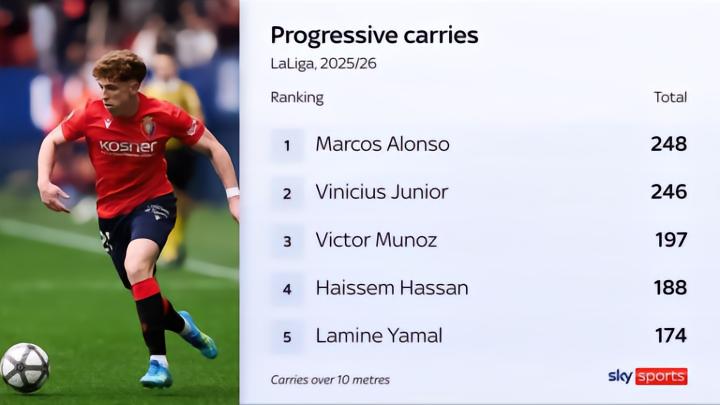
In terms of winning corner kicks, only three players rank ahead of him, all from La Liga's two biggest clubs. As for the number of times he has advanced more than 10 meters and helped his team carry the ball forward, only Vinicius Junior, another attacker, has more.
These statistics paint a picture of a game-changer who can bring more speed and impact to Liverpool in the opponent's half. The expectation is that he can use his speed to weaponize counter-attacks, as well as his essential dribbling skills to break down low blocks.
Muñoz still needs to adapt, that much is undeniable. At Osasuna, he enjoys a certain degree of freedom. While his shots rank among the top 10 in the league, his goals rank only outside the top 40, indicating that many of his shots come from long range or from tight angles.
His expected goals per shot is only 7.2%, significantly lower than Ektiker's 15.2%, Wirtz's 13.8%, and Salah's 12.0%. At Liverpool, he will have more opportunities and more passing options, thus requiring him to make better decisions.
But both Muñoz and Iraola's words convey the same message: Liverpool also needs to adapt to him. Iraola said, "I've talked to the coaching staff about what works and what can be done differently. I wouldn't say it's better, I would say it's different."
Liverpool are clearly eager to return to the "rock-and-roll football" that Salah mentioned in his farewell speech. Iraola's current task is to bring that kind of football to Anfield, and he has already brought Muñoz to help him achieve this goal.